
Introduction
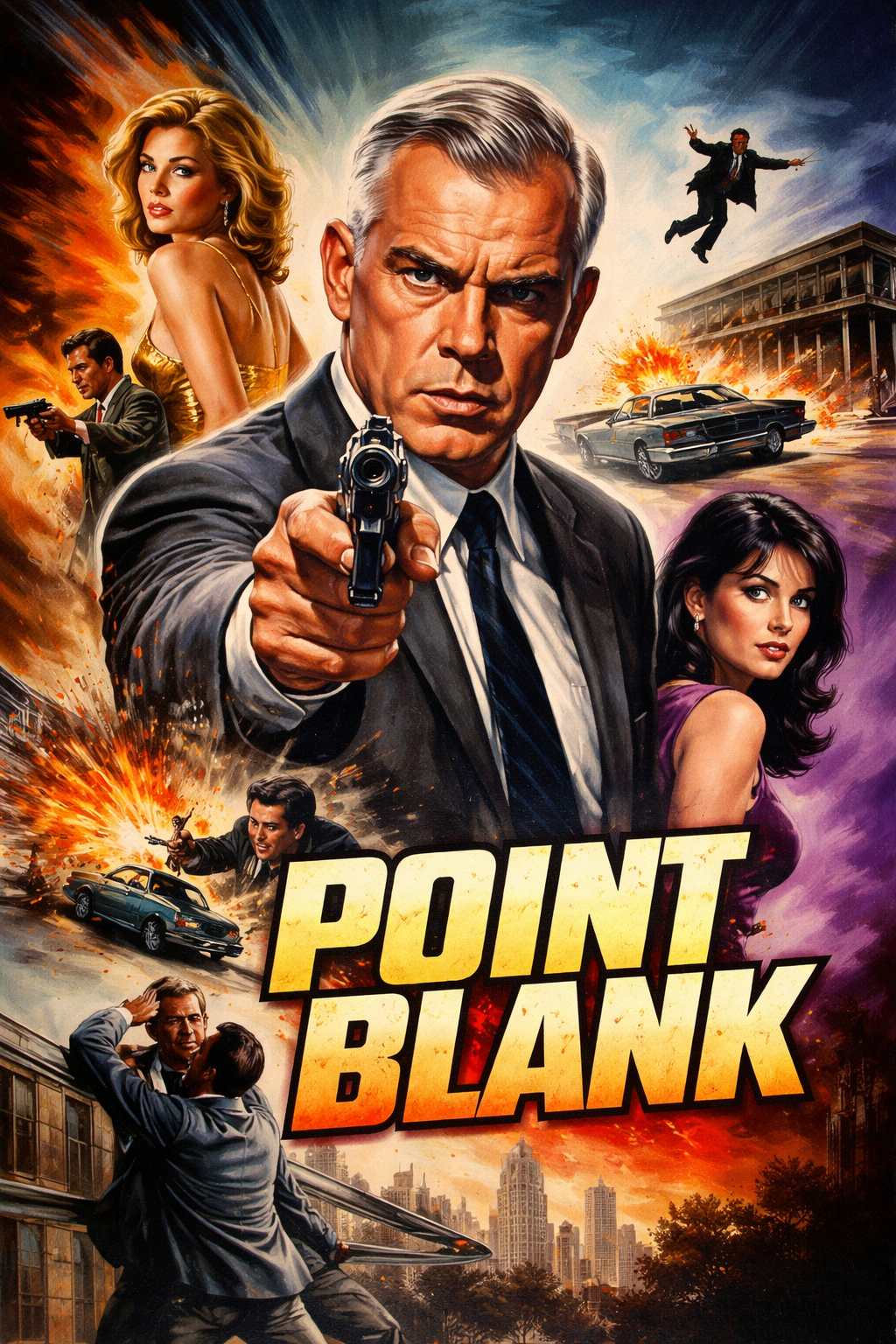
In the landscape of 1960s cinema, few films captured the essence of neo-noir with such raw intensity and innovative flair as Point Blank 1967. Directed by John Boorman in his first American feature, this crime thriller starring Lee Marvin as the enigmatic Walker redefined revenge narratives. Released during a time of cultural upheaval, Point Blank 1967 blended hard-boiled pulp fiction roots with modernist techniques inspired by the French New Wave, creating a film that felt both timeless and prophetic. Based on Donald E. Westlake’s novel The Hunter (written under the pseudonym Richard Stark), the movie follows a betrayed criminal’s relentless quest for payback, but it’s Boorman’s stylistic choices—fractured timelines, minimalist dialogue, and stark visuals—that elevate it beyond typical genre fare. Though it underperformed at the box office initially, Point Blank 1967 has since earned cult status, influencing directors from Quentin Tarantino to the Coen brothers with its cool detachment and existential undertones.
The film’s premise is deceptively simple: a man double-crossed during a heist seeks to reclaim his stolen share of $93,000 from a shadowy criminal syndicate known as “The Organization.” Yet, beneath this surface lies a meditation on identity, betrayal, and the mechanization of modern life. Marvin’s Walker is no anti-hero with redeeming qualities; he’s a force of nature, emotionless and unstoppable, navigating a world of sterile corporate crime that mirrors the alienation of post-war America. Point Blank 1967 arrived ahead of its time, foreshadowing the gritty realism of 1970s New Hollywood while paying homage to classic film noir. Its blend of violence and abstraction challenged audiences, making it a pivotal work in cinematic history.
Plot Summary
The story of Point Blank 1967 unfolds in a non-linear fashion, beginning with a heist gone wrong on the abandoned Alcatraz Island. Walker (Lee Marvin), a stoic career criminal, teams up with his friend Mal Reese (John Vernon) and his wife Lynne (Sharon Acker) to intercept a cash drop for a gambling operation. The plan succeeds, but betrayal follows swiftly: Reese shoots Walker, leaves him for dead in a desolate prison cell, and flees with the entire $93,000 haul—and Lynne.
Miraculously surviving, Walker escapes Alcatraz by swimming to San Francisco, though the film hints this survival might be more dreamlike than literal. Aided by the mysterious Yost (Keenan Wynn), who provides cryptic intel on “The Organization,” Walker relocates to Los Angeles to exact revenge. His journey is methodical: he confronts Lynne, who reveals Reese’s whereabouts before succumbing to guilt and overdose. Walker then enlists Lynne’s sister, Chris (Angie Dickinson), to infiltrate Reese’s life, leading to a tense confrontation where Reese meets a fatal end—falling from a high-rise penthouse.
As Walker climbs the syndicate’s hierarchy, encountering figures like Carter (Lloyd Bochner) and Stegman (Michael Strong), the violence escalates in calculated bursts. Each kill brings him closer to the money, but the film subverts expectations with its elliptical structure—flashbacks and repetitions blur the line between reality and Walker’s psyche. The climax returns to Alcatraz, where Yost’s true motives unfold, leaving Walker—and the audience—questioning the nature of his quest. Point Blank 1967 isn’t just a revenge tale; it’s a puzzle that rewards multiple viewings.
Cast and Performances
At the heart of Point Blank 1967 is Lee Marvin’s iconic portrayal of Walker, a role that cemented his status as Hollywood’s ultimate tough guy. Marvin, fresh off an Oscar win for Cat Ballou, brings a chilling minimalism to the character—his face a mask of impassivity, his movements predatory and efficient. Walker speaks sparingly, letting physicality convey rage; Marvin’s input shaped the film, granting Boorman creative control and insisting on a raw, unromanticized depiction.
Angie Dickinson shines as Chris, Walker’s reluctant ally and romantic interest, infusing the role with vulnerability and sensuality. Her scenes with Marvin crackle with tension, particularly a memorable sequence where she assaults him in frustration, only to collapse in exhaustion. John Vernon, in his breakout role as Reese, embodies sleazy ambition, while Carroll O’Connor (pre-All in the Family) adds gravitas as syndicate boss Brewster. Keenan Wynn’s Yost is enigmatic, hinting at deeper conspiracies, and supporting players like Sharon Acker and Michael Strong round out a cast that prioritizes authenticity over star power. The performances are understated, aligning with the film’s sparse aesthetic.
Directorial Style and Innovations
John Boorman’s direction in Point Blank 1967 marks it as a stylistic tour de force, blending American grit with European artistry. Influenced by Alain Resnais, Boorman employs jump cuts, non-linear editing, and sound design that fades into silence, creating a disorienting, dreamlike atmosphere. Cinematographer Philip H. Lathrop’s work is avant-garde, using wide-angle lenses and color palettes of cold blues and grays to depict Los Angeles as a sterile, futuristic wasteland—contrasting Boorman’s initial San Francisco plans for a harder edge.
The film’s violence is abrupt and unglamorous, often off-screen or implied, emphasizing psychological impact over gore. Johnny Mandel’s score mixes jazz and electronic elements, underscoring Walker’s isolation. Boorman’s innovations—shooting on Alcatraz location and resisting studio re-shoots—preserved the film’s integrity, thanks to editor Margaret Booth’s advocacy. This fusion of styles made Point Blank 1967 a bridge between classic noir and modern thrillers.
Themes and Symbolism
Point Blank 1967 delves into themes of existentialism, corporate dehumanization, and the futility of revenge. Walker represents the alienated everyman in a mechanized world, where “The Organization” symbolizes faceless bureaucracy—indistinguishable from legitimate business. Betrayal permeates every relationship, from marital infidelity to criminal double-crosses, highlighting trust’s fragility.
Symbolically, Alcatraz bookends the narrative as a metaphor for imprisonment—physical and psychological. Walker’s possible death-dream interpretation adds layers: is his journey real, or a dying hallucination? Colors and motifs, like echoing footsteps, reinforce isolation and repetition, critiquing consumerism and violence in American society. The film’s ambiguity invites reflection on morality in a amoral world.
Reception and Legacy
Upon release, Point Blank 1967 grossed over $9 million but received mixed reviews; critics like Bosley Crowther noted its sadism and lack of moral clarity, while others praised its innovation. Over time, it gained acclaim, with Roger Ebert hailing its fractured narrative as influential. Its legacy endures in remakes like Payback (1999) and inspirations for films such as Pulp Fiction and Memento. Scholars view it as a seminal neo-noir, blending genres and cultures. Today, Point Blank 1967 stands as a testament to visionary filmmaking, its style and themes resonating in contemporary cinema.
Conclusion
Point Blank 1967 remains a landmark revenge thriller, its stylish execution and forward-thinking approach ensuring its place in film history. Boorman’s masterpiece captures the disillusionment of its era while transcending it, offering a chilling portrait of vengeance in a cold world.
FAQ
What is the plot of Point Blank 1967?
The film follows Walker, a criminal betrayed by his partner Mal Reese during a heist on Alcatraz. Left for dead, Walker survives and methodically seeks revenge and his stolen $93,000 from a criminal syndicate.
Who directed Point Blank 1967?
John Boorman directed the film, marking his American debut. He collaborated closely with star Lee Marvin to shape its unique style.
Is Point Blank 1967 based on a book?
Yes, it’s adapted from Donald E. Westlake’s novel The Hunter, the first in the Parker series, written under the pseudonym Richard Stark.
Why is Point Blank 1967 considered ahead of its time?
Its non-linear storytelling, minimalist dialogue, and blend of noir with New Wave techniques influenced later films, making it feel modern even today.
Who stars in Point Blank 1967?
Lee Marvin leads as Walker, with Angie Dickinson as Chris, John Vernon as Mal Reese, and supporting roles by Keenan Wynn and Carroll O’Connor.
Was Point Blank 1967 a box office success?
It grossed over $9 million but was not an immediate hit. It later became a cult classic.
Is there a remake of Point Blank 1967?
Yes, Payback (1999) starring Mel Gibson is a remake, though it alters some elements.
What themes does Point Blank 1967 explore?
It examines betrayal, revenge, corporate crime, and existential alienation, often through symbolic and dreamlike sequences.
Where was Point Blank 1967 filmed?
Primarily in Los Angeles for its sterile aesthetic, with key scenes on Alcatraz Island, the first film shot there after its closure.
Why should I watch Point Blank 1967?
For its innovative style, powerhouse performances, and lasting impact on thrillers—it’s a must-see for fans of noir and revenge stories.