Introduction
In the vast universe of DC Comics, few archetypes capture the imagination quite like the speedsters. These characters, often associated with the iconic Flash mantle, embody the thrill of superhuman velocity, time manipulation, and heroic exploits. The DC Comics Flash characters represent a lineage of heroes and villains who tap into the Speed Force, a mysterious energy source that grants them unparalleled speed. From the Golden Age origins to modern reboots, the DC Comics Flash characters have evolved, influencing countless storylines across comics, TV shows, and films. This guide delves deep into the history, powers, key figures, and cultural impact of these speedsters, providing a comprehensive overview for fans old and new.
The concept of speedsters in DC Comics began with Jay Garrick, the original Flash, introduced in 1940. Over the decades, the Flash family has expanded, incorporating scientific accidents, mystical elements, and interdimensional threats. Understanding the DC Comics Flash characters requires exploring their connections to the Speed Force, a dimension of pure kinetic energy that powers their abilities. This force not only allows them to run at speeds exceeding light but also enables time travel, phasing through objects, and generating lightning. As we explore the DC Comics Flash characters, we’ll see how they symbolize hope, legacy, and the relentless pursuit of justice.
The Origins of the Flash Legacy
The Flash legacy traces back to the Golden Age of comics, where Jay Garrick became the first speedster. Created by Gardner Fox and Harry Lampert, Garrick inhaled heavy water vapors in a lab accident, gaining super speed. As the Flash of Earth-Two, he fought Nazis during World War II and was a founding member of the Justice Society of America. His helmet, inspired by the Roman god Mercury, became a symbol of swift heroism.
The Silver Age revitalized the DC Comics Flash characters with Barry Allen in 1956. Barry, a forensic scientist, was struck by lightning while surrounded by chemicals, connecting him to the Speed Force. Co-created by Robert Kanigher and Carmine Infantino, Barry’s debut in Showcase #4 sparked the superhero renaissance. Unlike Garrick, Barry’s powers were more scientifically grounded, allowing him to vibrate molecules and create cyclones. His tragic backstory—witnessing his mother’s murder—added depth, making him a cornerstone of DC Comics’ Flash characters.
Wally West, Barry’s nephew, took the mantle after Barry’s sacrifice in Crisis on Infinite Earths (1985). Initially, Kid Flash, Wally matured into the primary Flash, surpassing his mentor in speed and personality. His journey from sidekick to leader exemplifies the passing of the torch in DC Comics Flash characters.
Key Heroes Among DC Comics Flash Characters
Barry Allen: The Scarlet Speedster
Barry Allen is arguably the most famous of the DC Comics Flash characters. Portrayed as a dedicated CSI in Central City, Barry’s life changed forever with the Speed Force connection. His powers include running at Mach speeds, time travel via the Cosmic Treadmill, and enhanced healing. Barry’s optimism and scientific mind make him a relatable hero.
In story arcs like Flashpoint (2011), Barry alters the timeline to save his mother, leading to a dystopian world. This event reshaped the DC Universe, introducing the New 52 era. Barry’s relationships, especially with Iris West, add emotional layers. As leader of the Flash family, he mentors younger speedsters, ensuring the legacy endures.
Wally West: The Fastest Man Alive
Wally West’s evolution from impulsive teen to seasoned hero is a highlight among DC Comics Flash characters. After gaining powers from a replicated lab accident, Wally joined the Teen Titans and later the Justice League. His tenure as Flash in the 1990s, under writers like Mark Waid, introduced concepts like Speed Force absorption, allowing infinite acceleration.
Wally’s personal growth—overcoming self-doubt and family responsibilities—resonates with readers. In The Flash vol. 2, he battles villains like Savitar and Abra Kadabra, expanding the speedster mythology. Wally’s return in DC Rebirth (2016) as a multiversal traveler reaffirms his status.
Jay Garrick: The Golden Age Pioneer
As the original Flash, Jay Garrick laid the foundation for all DC Comics Flash characters. His chemical inhalation granted speed, strength, and agility. Jay’s role in the Justice Society and later crossovers with younger Flashes highlight generational themes.
In modern stories, Jay mentors Impulse and fights alongside the Justice League. His enduring marriage to Joan Williams provides stability amid chaos.
Bart Allen: Impulse and Beyond
Bart Allen, grandson of Barry, hails from the 30th century. Born with uncontrollable speed, he was aged rapidly in a virtual reality. As Impulse, Bart’s hyperactivity led to humorous yet heroic moments in Young Justice.
Bart briefly became Kid Flash and then Flash after Wally’s disappearance. His death and resurrection in Infinite Crisis underscore the risks of speedster life. Bart’s blend of future tech and innate speed makes him unique among DC Comics Flash characters.
Other Notable Heroes
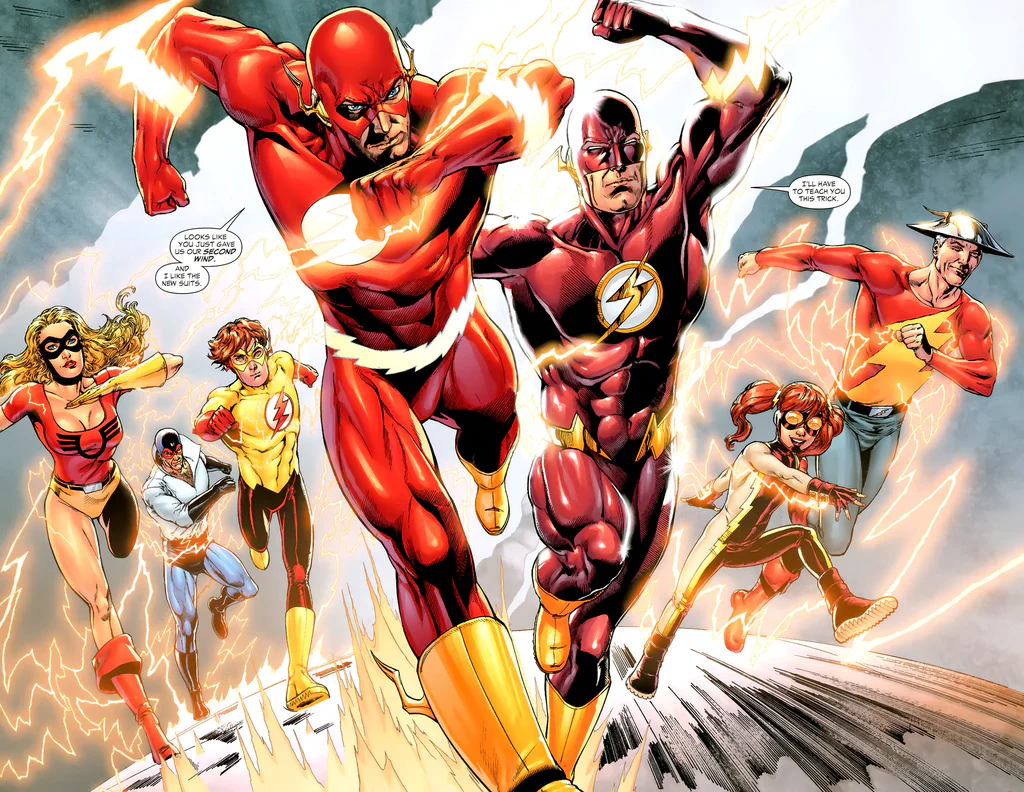
The Flash family includes Jesse Quick (daughter of Liberty Belle and Johnny Quick), who combines strength with speed via a mathematical formula. Max Mercury, the “Zen Master of Speed,” guides speedsters through Speed Force wisdom. Irey West, Wally’s daughter, represents the next generation with phasing abilities.
Villains: The Dark Side of Speed
No guide to DC Comics Flash characters is complete without their rogues. These antagonists often mirror the heroes’ powers, creating intense rivalries.
Eobard Thawne: Reverse-Flash
Eobard Thawne, the Reverse-Flash, is Barry’s arch-nemesis. A 25th-century fan obsessed with Barry, Thawne replicated his powers but turned villainous. Connected to the Negative Speed Force, he manipulates time, famously killing Barry’s mother.
Thawne’s vendetta spans timelines, appearing in The Flashpoint Paradox and TV adaptations. His yellow suit and red eyes symbolize inverted heroism.
Hunter Zolomon: Zoom
Hunter Zolomon, as Zoom, seeks to “improve” heroes through tragedy. Paralyzed and empowered by a time explosion, Zoom slows time relatively, appearing faster. His psychological warfare against Wally West in Blitz arc is chilling.
Gorilla Grodd: The Telepathic Ape
While not a pure speedster, Grodd’s psychic powers and enhanced strength challenge Flashes. Ruling Gorilla City, he uses mind control and technology against Central City.
Other Rogues
Captain Cold (Leonard Snart) uses cold guns to counter speed. Mirror Master (Sam Scudder) manipulates reflections for traps. The Trickster (James Jesse) employs gadgets with a clownish flair. These villains form the Rogues gallery, emphasizing strategy over brute force.
The Speed Force: Powers and Mechanics
The Speed Force is the ethereal energy binding DC Comics Flash characters. Discovered by Barry, it’s an extra-dimensional field generated by all motion. Speedsters draw from it for super speed, but overuse risks absorption into it.
Powers include:
- Super Speed: Running faster than light, creating afterimages.
- Time Travel: Entering timelines via velocity.
- Phasing: Vibrating through solids.
- Healing: Accelerated metabolism mends wounds.
- Lightning Generation: Throwing Speed Force bolts.
Limitations exist: Momentum can cause accidents, and disconnecting from the Speed Force depowers them. In Flash War (2018), Barry and Wally’s clash reveals Speed Force secrets.
Cultural Impact and Adaptations
DC Comics Flash characters have transcended pages into media. The 1990 TV series starred John Wesley Shipp as Barry. The CW’s The Flash (2014-2023), with Grant Gustin, popularized multiverse crossovers.
Films like Justice League (2017) feature Ezra Miller’s quirky Barry. Animated series such as Justice League Unlimited showcase Flash’s humor.
Comics influence includes speedster tropes in other media, like Quicksilver in Marvel. The Flash’s optimism inspires real-world charity runs and STEM education.
Evolution Through Crises and Reboots
DC’s events reshape DC Comics Flash characters. Crisis on Infinite Earths merged Earths, killing Barry temporarily. Infinite Crisis revived him. Flashpoint birthed New 52, altering histories.
DC Rebirth restored legacies, reuniting Flashes. Recent arcs explore multiversal threats, keeping the mythos fresh.
The Flash Family Dynamics
The Flash family emphasizes mentorship and bonds. Barry and Wally’s uncle-nephew relationship evolves into a partnership. Iris West anchors them emotionally.
In The Flash vol. 5, family team-ups against Godspeed highlight unity. These dynamics humanize god-like powers.
Collectibles and Fandom
Fans collect Flash memorabilia: action figures, comics like Flash #1 (1959, value $100,000+). Conventions feature cosplay and panels on Speed Force theories.
Online communities discuss feats, like Barry’s infinite mass punch.
Conclusion: The Enduring Legacy
The speedsters of DC Comics Flash characters continue to race forward, embodying speed, sacrifice, and spirit. From Jay’s pioneering days to future generations, they remind us that heroism is about moving ahead, no matter the obstacles.
FAQ
What is the Speed Force in DC Comics?
The Speed Force is an extra-dimensional energy source that grants speedsters their powers, allowing super speed, time travel, and more.
Who was the first Flash?
Jay Garrick, introduced in 1940, was the original Flash during the Golden Age.
How did Barry Allen get his powers?
Barry was struck by lightning in a chemical lab, connecting him to the Speed Force.
Who is the fastest Flash?
Wally West is often considered the fastest, having absorbed more Speed Force energy than others.
What is Reverse-Flash’s real name?
Eobard Thawne, a future descendant obsessed with Barry Allen.
Has the Flash ever died?
Yes, Barry sacrificed himself in Crisis on Infinite Earths, but he has returned multiple times.
Are there female speedsters in the Flash family?
Yes, like Jesse Quick and Irey West, who carry on the legacy.
What TV show features the Flash?
The CW’s The Flash starred Grant Gustin as Barry Allen from 2014 to 2023.
Can speedsters time travel?
Yes, by running at extreme speeds or using devices like the Cosmic Treadmill.
Who leads the Rogues gallery?
Captain Cold often leads, with members like Heat Wave and Mirror Master.