
Introduction
In the glossy, blood-spattered world of Guy Ritchie’s storytelling, few premises capture the chaotic fusion of privilege and peril quite like The Gentlemen (2024 TV Series). Premiering on Netflix in March 2024, this eight-episode action-comedy drama spins off Ritchie’s 2019 film of the same name but carves out its own territory with fresh characters, sharper class satire, and an unrelenting focus on the themes announced in its very title: crime, class, and control.
At its core, The Gentlemen (2024 TV Series) follows Eddie Horniman, a disciplined British Army captain and second son of the Duke of Halstead, who unexpectedly inherits the family’s sprawling 15,000-acre estate and title upon his father’s death. What begins as a noble homecoming quickly descends into a criminal quagmire when Eddie discovers the estate secretly hosts a massive cannabis empire. The operation, run by the imprisoned kingpin Bobby Glass and his formidable daughter Susie, binds the aristocracy to the underworld in a partnership as lucrative as it is lethal. Eddie’s desperate bid to extricate his family plunges him deeper into violence, betrayal, and moral compromise.
Over eight fast-paced episodes, The Gentlemen (2024 TV Series) dissects how crime thrives at the intersection of inherited wealth and street-level hustle. It mocks the British class system while questioning who truly holds power in a society where dukes and drug lords operate under the same rules. This article explores those pillars—crime, class, and control—through plot, character, style, and cultural resonance, revealing why The Gentlemen (2024 TV Series) remains one of Netflix’s most stylish and thought-provoking crime dramas of the 2020s.
Plot Overview: Inheritance, Empire, and Entanglement
The Gentlemen (2024 TV Series) wastes no time establishing its high-stakes premise. Eddie (Theo James) returns from a UN peacekeeping mission in the Middle East to find his father on his deathbed. The will’s shocking revelation names Eddie—not his older, cocaine-fueled brother Freddy—as the 13th Duke of Halstead. The estate, a Downton Abbey-esque manor with manicured grounds and hidden grow-ops, generates millions annually through Bobby Glass’s (Ray Winstone) weed empire. Susie Glass (Kaya Scodelario) runs day-to-day operations while her father serves time.
Eddie’s initial impulse is clean: shut down the illegal side and restore aristocratic respectability. But debts, rivals, and family dysfunction force his hand. A local gangster demands repayment for Freddy’s gambling losses. An ambitious American businessman, Stanley Johnston (Giancarlo Esposito), eyes the estate for his own meth empire. Rival crews steal shipments, triggering violent reprisals. Each episode layers caper upon caper—fixed boxing matches, stolen weed hauls, blackmail schemes—while Eddie evolves from reluctant outsider to calculating player.
By season’s end, Eddie has blood on his hands and a taste for the game. The narrative arc of The Gentlemen (2024 TV Series) mirrors classic Ritchie fare: intricate schemes, double-crosses, and a finale that ties loose ends with explosive flair. Yet the series expands the universe, introducing new estates, international distribution woes, and deeper family secrets, setting the stage for its already-confirmed second season expected in 2026.
The Underworld Empire: Crime as Business in The Gentlemen (2024 TV Series)
Crime in The Gentlemen (2024 TV Series) is never chaotic for chaos’s sake; it is meticulously organized, almost corporate. The cannabis grow-ops hidden beneath manicured lawns symbolize the marriage of old money and new vice. Bobby Glass’s empire supplies premium products to elite clients while laundering profits through legitimate aristocratic channels. This setup allows Ritchie to satirize how crime scales: from street-level dealers to boardroom-level kingpins who wear tailored suits and speak in polished accents.
Violence is stylized yet visceral—brass knuckles, shotguns, and improvised weapons punctuate negotiations. A memorable sequence involves a botched shipment leading to a countryside shootout that blends slapstick with brutality. Crime here functions as survival: Eddie learns that refusing the game invites worse predators. Susie’s cold pragmatism contrasts with Eddie’s military honor, illustrating how the underworld rewards adaptability over morality.
Ritchie draws parallels between drug cartels and legitimate business. Distribution networks mimic supply chains; loyalty is contractual; betrayal is bankruptcy. The Gentlemen (2024 TV Series) critiques the hypocrisy of “respectable” crime aristocrats who tut-tut at street gangs while profiting from the same trade. The series never glorifies violence but uses it to expose systemic rot: when the law favors the powerful, crime becomes the great equalizer.
Class Warfare, British Style: Aristocracy Meets the Streets
Class is the beating heart of The Gentlemen (2024 TV Series). Ritchie repeatedly hammers home the joke: British aristocrats are the original gangsters. As Esposito’s Stanley quips, “William the Conqueror was worse than Al Capone.” The Horniman family’s centuries-old title rests on stolen land and feudal power, making their discomfort with modern criminals deliciously ironic.
Eddie embodies the tension. A “gentleman” by birth and soldier by training, he recoils at the vulgarity of gangsters yet deploys the same ruthlessness. Freddy’s entitled idiocy—snorting lines at dinner while the family teeters on ruin—highlights generational decay among the upper crust. Their mother, Sabrina (Joely Richardson), clings to decorum, blind to how her lifestyle depends on illicit cash.
Susie Glass represents the aspirational working class: sharp, stylish, and unapologetic. Her polished demeanor masks street smarts forged in Bobby’s shadow. The friction between her and Eddie fuels chemistry and commentary. The Gentlemen (2024 TV Series) refuses simplistic “us vs. them” tropes; instead, it shows both worlds corrupted by the same hunger for control. Groundkeeper Geoff Seacombe (Vinnie Jones), a salt-of-the-earth loyalist, bridges the divide, reminding viewers that loyalty transcends class.
The satire peaks in scenes contrasting white-glove dinners with bloody basement meetings. The Gentlemen (2024 TV Series) argues that class mobility is illusory—true power flows through money and muscle, regardless of pedigree.
Control, Legacy, and the Illusion of Power
Control emerges as the series’s most nuanced theme. Eddie believes he can dictate terms—exit the deal, protect his family, preserve honor. Reality teaches otherwise. Every move to seize control tightens the noose: debts mount, alliances fracture, and personal loyalties strain.
The estate itself becomes a battleground for control. Bobby Glass retains ownership of the empire from prison, Susie maneuvers as a proxy, and external players like Stanley scheme buyouts. Eddie’s signet ring, emblazoned with the family motto “Non sine periculo” (Not without danger), symbolizes an inherited burden.
Family dynamics amplify the struggle. Freddy’s recklessness forces Eddie into guardianship; sister Charly’s innocence tests his resolve. Susie’s fierce protectiveness of her imprisoned father mirrors Eddie’s duty to the legacy. Control extends to narrative agency—Ritchie’s characters constantly narrate their schemes, blurring storyteller and story.
Ultimately, The Gentlemen (2024 TV Series) posits that true control is illusory. Power shifts through negotiation, betrayal, and adaptation. Eddie’s arc from reluctant duke to budding crime lord illustrates how environments shape identity: the “zoo” of aristocracy yields to the “jungle” of the underworld.
Key Characters: Performances That Anchor the Chaos
Theo James delivers a career-high turn as Eddie. His transformation from stoic officer to charismatic operator is subtle yet magnetic—every raised eyebrow conveys calculation. Kaya Scodelario’s Susie is the series’s secret weapon: ice-cold yet vulnerable, her chemistry with James crackles with unspoken tension. Daniel Ings steals scenes as Freddy, blending comic relief with tragic pathos. Ray Winstone’s Bobby, though mostly behind bars, radiates menace via phone calls and flashbacks. Giancarlo Esposito brings gravitas to Stanley, while Vinnie Jones grounds the ensemble with quiet loyalty.
Supporting players—Jasmine Blackborow’s Charly, Harry Goodwin’s Jack—add texture. The cast’s ensemble energy elevates The Gentlemen (2024 TV Series) beyond plot mechanics into character-driven drama.
Style, Humor, and Ritchie’s Signature Flair
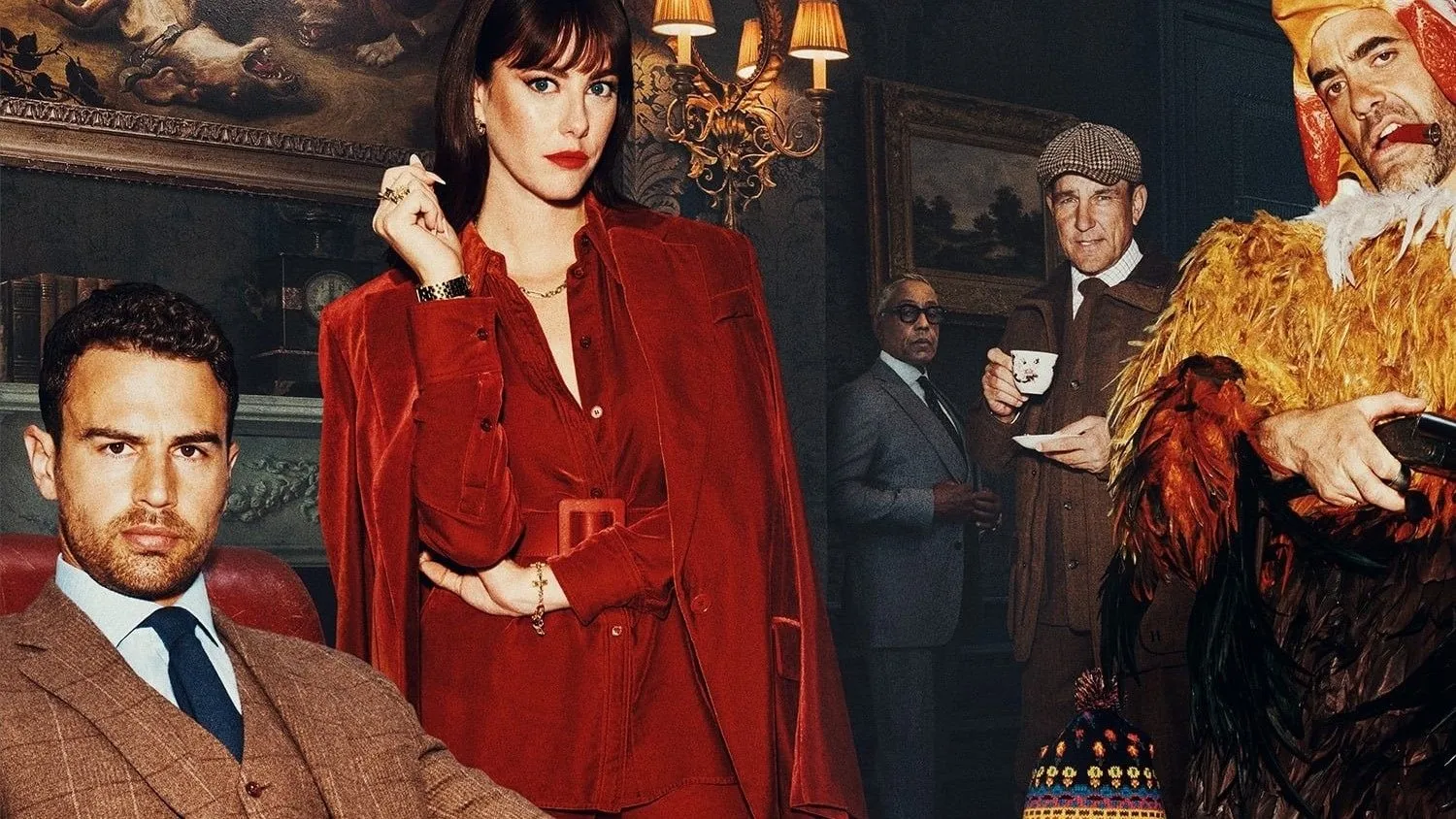
Visually, The Gentlemen (2024 TV Series) is pure Ritchie: rapid cuts, kinetic camerawork, and lush cinematography that makes the English countryside look both idyllic and sinister. Costumes scream status—Susie’s power suits rival any gangster’s tracksuit. Dialogue snaps with Cockney slang and aristocratic wit, delivering laugh-out-loud one-liners amid tension.
Humor arises from absurdity: a duke negotiating with thugs over tea; a groundskeeper wielding a shotgun like Excalibur. Yet the series balances levity with stakes, ensuring violence never feels gratuitous. This tonal tightrope is The Gentlemen (2024 TV Series)’s greatest strength.
Reception: Critical Praise and Cultural Footprint
The Gentlemen (2024 TV Series) earned a 75% Rotten Tomatoes critic score and 84% audience approval, praised for slick storytelling, cast chemistry, and verve. Detractors noted occasional convolution and style-over-substance moments, but most agreed it stands strongly on its own. UK viewership exceeded 3.5 million in its debut week, cementing Netflix’s success.
Culturally, the series reframes British identity in a post-Brexit, class-conscious era. Its satire resonates globally, reminding audiences that power structures everywhere blend privilege with predation.
Conclusion: Why The Gentlemen (2024 TV Series) Endures
The Gentlemen (2024 TV Series) triumphs by weaving crime, class, and control into a riveting tapestry. It entertains with capers and charisma while probing deeper questions: Who are the real criminals? What price does legacy exact? As Eddie learns, danger lurks not in the jungle but in failing to adapt to it. With season two on the horizon, The Gentlemen (2024 TV Series) promises continued evolution. In a television landscape craving bold, stylish storytelling, this series stands tall—suited, booted, and unapologetically dangerous.
FAQ
What is The Gentlemen (2024 TV Series) about? It follows aristocratic Eddie Horniman, who inherits a dukedom and discovers his estate hides a massive illegal cannabis empire. He must navigate the criminal underworld while protecting his family.
Is The Gentlemen (2024 TV Series) connected to the 2019 movie? Yes, it exists in the same universe but features an entirely new cast and story. No prior viewing is required.
Who are the main cast members in The Gentlemen (2024 TV Series)? Theo James (Eddie Horniman), Kaya Scodelario (Susie Glass), Daniel Ings (Freddy Horniman), Ray Winstone (Bobby Glass), Giancarlo Esposito (Stanley Johnston), Joely Richardson (Sabrina Horniman), and Vinnie Jones (Geoff Seacombe).
How many episodes are in season 1 of The Gentlemen (2024 TV Series)? Eight episodes, all released on Netflix on March 7, 2024.
Does The Gentlemen (2024 TV Series) contain spoilers in this article? Major plot twists are avoided; focus remains on themes and general arcs.
Is there a season 2 of The Gentlemen (2024 TV Series)? Yes, renewed in 2024 and filmed for a 2026 Netflix release.
What age rating does The Gentlemen (2024 TV Series) have? TV-MA due to strong language, violence, drug content, and sexual situations.
Why should I watch The Gentlemen (2024 TV Series)? For sharp wit, stellar performances, stylish action, and clever commentary on class and power—all delivered in classic Guy Ritchie fashion.